
Eating Healthy: the Basics
1. What is a healthy breakfast?
2. What is a healthy lunch?
3. What is a healthy dinner?
4. How much should I weigh?
5. How many calories should I be eating?
6. What is the best way to lose
weight?
7. How can I keep my weight loss
goal in mind and stay motivated?
8. What is a healthy weekly weight loss?
9. How to set weight loss goals and make
them happen
10. How to keep a food diary, and
why it is essential to successful weight loss
11. Are all fats bad for you?
12. Are saturated fats bad
for you?
13. Are
unsaturated fats good for you?
14. Are carbohydrates bad for you?
15. Is fiber good for you?
16. How to read nutrition/food labels
17. How to plan your weekly menus
18. Why should I eat less salt?
19. What
do the sodium (salt) numbers mean on food labels?
20. What is The Mediterranean Diet?
21. Why eating vegetables is good for
you
22. Why eating fruit and nuts
is good for you
23. Why are cereals and whole grains good for you?
24. What are legumes, and why are they good for you?
25. Why is eating fish good for you?
26. Which fats and oils are good for
you?
27. Are dairy products good for you?
28. Which meats should I not eat?
29. Is drinking alcohol good for
you?
30. Is it important to measure your
ingredients?
31. Are snacks good for you?
32. How to choose the right portion size
33. Can you lose weight with a smaller
plate?
34. Eat healthier by cleaning out your
pantry
35. Which oils and fats should I keep in my pantry?
35. Which oils and fats are good for you - and when should I use them?
36. Which carbohydrates are good for you?
37. What is the best chicken or turkey for you?
38. Are dairy products good for you?
39. Which nuts and seeds should I eat?
40. Is red meat like beef or pork bad or good for you?
41. Is eating dessert good or bad for
you?
42. Is drinking soda bad for you?
43. Is drinking coffee bad for you?
44. How can healthy food taste good? Part 1
45. How can healthy food taste good? Part
2
46. How to eat healthy while eating
out
47. Are vitamins and supplements necessary
to eat healthy?
48. How to eat healthy while traveling
Eating Healthy: the Basics
What is a healthy breakfast?
When I am working with patients I have learned that I can't help them fix everything at one appointment. Beyond the fact that there is simply not enough time in a visit, most of us can't tackle more than a few changes in our life at any one time. Sometimes I start discussing breakfast and other times lunch or snacks, but if I can engage folks to get started on eating healthy I prefer that they begin their change with the first meal of the day.
First off, most of us don't eat all that healthy, and getting the day started with something healthy both makes sense and is backed up by research pretty well. When you get up at 6:00 am it's likely that you have not eaten for 10 or 12 hours and not only is your body in need of some calories, there are daily hormonal cycles that have us programmed to eat early in the day. Going without food for that many hours alters the body's metabolic rate to hold onto stored calories, affecting your ability to maintain a healthy weight. Skipping breakfast not only means that you are working at odds with your body, but also by the time mid-morning rolls around, you are likely to be even hungrier and there is a greater chance that you will not make the best choices for your first meal of the day.
Many studies have shown that when those who are overweight consume more of their daily calories before noon they have an easier time losing weight. It has also been shown that breakfast-skippers have a higher BMI and, interestingly, breakfast eaters with a lower Body Mass Index are more likely to eat meals more regularly throughout the day. (AJCN l992;55:645-5l) Eating early in the day means you are less likely to snack later on, and research shows that people who eat breakfast snack more sensibly later in the day.
For example, in one study researchers found that participants who ate high-fiber cereals for breakfast ate less pizza at a meal served later in the day than those who ate a low-fiber cereal or white bread. The also found that the subjects' appetite levels fifteen minutes after eating were also much lower for those who ate the high-fiber cereal. Those who ate the low fiber cereal had the next highest appetite, followed by those who had white bread and then by those who had water. The higher fiber meals also helped keep the subjects' blood glucose levels more stable after their meals.
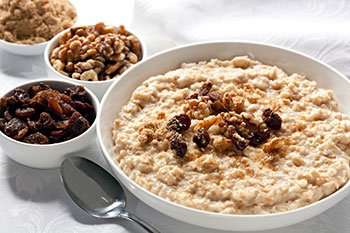
Eating a high fiber cereal at breakfast will help you feel less hungry at lunch. Compare the fiber levels of your favorite cereals or breads and pick the one that will keep you feeling fuller longer.
The prototype for your breakfast should be a great quality, higher fiber carbohydrate along with some protein and a piece of fruit. For example, an egg sandwich on whole wheat toast and a banana: good quality protein in the egg (with some equally good fats) and whole grain bread.
Researchers reviewing data from a large study of physicians found those who consumed two servings of high-fiber cereal per week had 20% lower rates of congestive heart failure. (Arch Int Med 2007;167:2080-2085) In another research study participants who ate cereals, quickbreads (like banana bread or zucchini bread) or muffins had a lower BMI when compared to those having meat and eggs, likely because the meat and egg eaters tended to consume more calories. Those having whole grain and cooked cereals fared better for folks than the ready to eat cereals or muffins. (JACN 2003, 22: 296-302)
I don't believe that the eggs mentioned in this research are necessarily the problem and eggs are a good choice for breakfast, in my opinion. It's generally what we pair with the eggs that's the problem: a couple of slices of bacon and toast and potatoes and juice. As with so many of our meals, it is the add-ons that are the challenge - not the basic ingredients. In fact, in one weight loss study of participants who had reduced their caloric intake, those who had eggs for breakfast tended to lose 65% more weight than those who had bagels for breakfast. The egg eaters also reduced their BMI by an additional 61% over the bagel breakfasters, all without increasing the participants' cholesterol levels. (Int J of Obesity, 2008: 21, 1545-1551)
Eggs are a great source of protein, quality fats, and B vitamins, but there was a time when everyone thought eggs were bad for us. Fortunately, that has now been soundly debunked. This includes both the idea that eggs cause disease and that eggs are a problem for diabetics. In one of my favorite studies a team in Australia recruited 121 overweight or obese men and women who had been diagnosed with diabetes or pre-diabetes to participate in a three-month dietary study known as DIABEGG (Diabetes and Egg) (AJCN 2015;101:705-13). Half were assigned to a "High Egg group" and half were assigned to a "Low Egg group." Those in the High Egg group were instructed to eat 2 eggs per day at breakfast, while those in the Low Egg group were told to eat no more than 2 eggs per week, while having 10 grams of lean animal protein (beef, chicken, or fish) at breakfast.
Both groups were counseled by a dietitian on replacing foods high in saturated fats with foods high in poly- and mono-unsaturated fats (for example, replacing butter with olive oil). Both groups' diets were designed to maintain the individual's body weight and both groups were told to maintain their usual level of physical activity. After three months the researchers compared the participants' cholesterol scores, glucose levels, and hemoglobin-A1c scores (a measure of diabetic control), from the start and end of the study and found that there were no significant changes in HDL cholesterol (the good cholesterol), LDL cholesterol (the bad cholesterol), or triglycerides, regardless of whether the participant ate 12 eggs per week or less than 2. Nor were there any changes in glucose levels or HbA1C scores.
Even better, those in the High Egg group reported being happier with the variety of food choices in their diet as well as feeling more satisfied after meals.
Eating breakfast regularly actually helps improve cholesterol profiles. One study found that women who didn't eat breakfast have higher total cholesterol and LDL (bad) cholesterol. Those women also had developed problems in how their insulin responds to eating. Such changes in insulin response are now clearly linked to a higher risk of heart disease and diabetes. (AJCN 2005;81:388-96)
But should you have a big breakfast, or a small one? Because we Americans are used to eating our largest meal in the evening, I advise my patients aiming for 1500 calories per day to have between 250 and 500 calories at their breakfast meal, about the same at lunchtime, and the remainder at the evening meal. Research, however, suggests that those who are working on losing weight might do better to reverse that pattern of small meal in the morning/large meal in the evening (Obesity, 2013;21:2504-2512).
For their study the researchers recruited 74 overweight and clinically obese women to participate in a 12-week diet study. All of the women met with a dietitian to plan for a 1400 calorie per day daily intake. Half of the women were directed to eat half of their calories at breakfast, while the other half were directed to eat half their daily calories at the evening meal. All of the women had their cholesterol, glucose, and insulin sensitivity tested along with their blood pressure at the start of the study as well as at regular intervals throughout the study.
You would think that eating the same number of calories would mean losing about the same amount of weight regardless of when those calories were eaten. Not so! The women who ate the majority of their calories at the breakfast meal lost about 11% of their body weight, while those who ate a big dinner lost only 4% of their body weight.
Not only did they lose more weight, their blood pressures, insulin resistance, and cholesterol scores improved more than those eating the big evening meal. (Indeed, those eating the large evening meal actually saw their triglycerides increase by almost 15% while the big breakfast eaters reduced their triglycerides by about 30%.)
Studies go on and on to reinforce the idea that breakfast is the most important meal of the day. Start with a high fiber cereal or whole grain toast, muffins, or quickbreads and you'll be satisfied and less likely to eat more during the day.
What's a healthy breakfast? Here are some suggestions.