
The Diabetic Diet
What is the right diet for people with diabetes? What is the best way for diabetics to control their blood sugars?
Over the years there have been a number of different strategies for diabetic diets. For a long time diabetics were taught to use exchange lists, but a lot of people found it complicated and hard to use. More recently the training has focused on counting carbohydrates at each meal or snack. For diabetics who take insulin (Type 1 diabetics), carefully regulating when and what they eat is key and counting carbs in this way works well for them.
Most diabetics, however, have Type 2 diabetes and don't take insulin. For these folks I have long felt that simply following a healthy diet is the best choice. A study published recently says that a Mediterranean style diet is the best diet for helping control Type 2 diabetes. [More research here!]
 Researchers
in Naples, Italy randomized 215 Type 2 diabetics to either a low fat diet
similar to the one now recommended by the American Diabetic Association,
or a Mediterranean style diet providing about 50% of calories from carbohydrates
and 30% from fat. These were patients who had just been diagnosed with
diabetes.
Researchers
in Naples, Italy randomized 215 Type 2 diabetics to either a low fat diet
similar to the one now recommended by the American Diabetic Association,
or a Mediterranean style diet providing about 50% of calories from carbohydrates
and 30% from fat. These were patients who had just been diagnosed with
diabetes.
The study looked at the number of diabetics who needed to be put on blood sugar medication after following the assigned diet for a certain amount of time. The results are pretty amazing. You would think that those who followed the American Diabetic Association diet would be able to manage their diabetes using only the diet, but this was not the case. 56% of those who followed the Mediterranean style diet did not have to go on medication to manage their blood sugars, while 70% of those following the low fat American Diabetic Association style diet ended up taking medications to control their blood sugars. Further, those on the Mediterranean style diet also lost more weight and had a greater improvement in their cholesterol and blood pressure scores.
We now have proof that the Mediterranean style diet is the best diet to control blood sugars for those with Type 2 diabetes. All of the Dr. Gourmet recipes and meal plans, such as those created using The Dr. Gourmet Diet Plan, are based on Mediterranean Diet principles and are perfect for those with Type 2 diabetes. Learn more about the Mediterranean Diet.
Research Articles on Diabetes
Whole Grains, Bran Fiber and Diabetes
Over the last several years I've written plenty of articles about the
positive effects of eating more fiber and whole grains. Eating more fiber
can help adolescents reduce their risk
of developing diabetes, while eating more fiber can help overweight
adults lose more
fat in their abdomen - which in and of itself is a risk factor for
diabetes.
A Little More Fiber Can Help You Reduce Your Risk of Diabetes
More and more children and adolescents are considered overweight or even obese,
leading to a related rise in the cases of insulin resistance, pre-diabetes,
and type 2 diabetes among children.
BMI, WHR, and your risk of diabetes:
I've written previously about Body Mass Index and Waist to Hip ratio and their
usefulness in assessing your overall health. There's been some controversy in
medical circles, however, about whether Body Mass Index (BMI), Waist to Hip
Ratio (WHR) or simple Waist Circumference (WC) is a better predictor of type
2 diabetes.
Carbohydrates and Diabetes
Some studies have linked high glycemic index (GI: how quickly a carbohydrate
is absorbed) and high glycemic load (GL: the glycemic effect of carbs
in the diet) with an increased risk of Type 2 diabetes. In Western
diets, these foods include bread, potatoes, and sweet foods like
desserts or sweetened soft drinks - a large portion of the typical Western
diet.
Get Your Magnesium: Avoiding Type
2 Diabetes
We know that obesity is the single strongest risk factor for developing type
2 diabetes. That said, it also appears that eating certain foods helps to reduce
the risk of type 2 diabetes. These foods, which include whole grains, beans,
nuts, and fruits and vegetables, are all high in magnesium. Magnesium is involved
in the metabolism of glucose and it is thought that it then plays a role in the
body's use of insulin - and therefore type 2 diabetes.
A Look at Vinegar and Diabetes
There may be something to vinegar and diabetes after all: two studies from
Arizona State University's Department of Nutrition, led by Carol S. Johnston,
PhD., suggest that taking apple cider vinegar orally may help improve insulin
sensitivity and glucose levels.
To help prevent diabetes, take... wine?
One of the interesting things about scientific research is that sometimes you
start out to discover one thing and end up finding something else. Recently
a group of scientists from the University of Minnesota set out to investigate
whether a diet rich in flavonoids (an antioxidant found in fruits, vegetables,
and beverages like tea or wine) might help reduce the risk of Type 2 diabetes.
More Good News for Coffee Drinkers
About a month ago I shared with you an article regarding the long-term
effects of caffeine intake among women. That study indicated that not
only does caffeinated coffee not cause hypertension, drinking more caffeinated
coffee (rather than only a cup or two a day) may actually help prevent
hypertension. Now I have even more good news for those who drink caffeinated
coffee.
More Reason to Get More Whole Grains
Researchers at Johns Hopkins recently published a study which focused on the
relationship between eating whole grains, refined grains, or cereal fiber and
risk factors for heart disease, high cholesterol, and diabetes.
Ask Dr. Gourmet
Dear Dr. Gourmet, My husband is 5'10" and 150 lbs. and was diagnosed with pre diabetes. We have been trying to find out how many carbs a day he should be eating or how many carbs per meal.
He does not need to lose weight and trying to maintain his current weight without eating a lot of carbs is difficult. He is very active in his job and cannot afford to lose any weight.
It seems everything that I read is for people to lose weight to help control their condition. Please can you give me a guideline of how to control the pre diabetes without losing any weight.
Dr. Gourmet Says....
You are correct that most of our patients who have "pre-diabetes" are overweight. Those that are trim pose a little bit more of a challenge because often those who are overweight can work at losing weight and will have marked improvements in their blood sugar. The same principles apply, however, for your husband who is in the normal weight range. Read the full answer.
Just Tell Me What to Eat!
The Delicious 6-Week Weight Loss Plan for the Real World
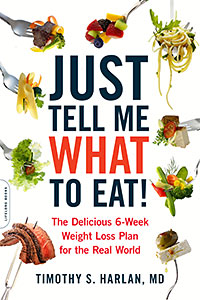
Timothy S. Harlan, MD, FACP has counseled thousands of his patients on healthy, sustainable weight loss. Now he's compiled his best tips and recipes into a six-week plan for you to learn how to eat great food that just happens to be great for you.
Get the prescription for better health as well as healthy weight loss, including:
What to eat
How to cook it
When to eat it
What to eat at a restaurant
What to eat if you're in a hurry
and best of all....
Why eating great food is the best health decision you'll ever make.