
Mediterranean Diet Basics
The basics of the Mediterranean diet can be broken into 9 important areas of change for your health:
1. Vegetables -
This one's pretty easy. It’s hard to eat too
many vegetables...
2. Legumes - Making beans your choice for
a starch...
3. Fruits and nuts - Fruit is the perfect snack...
4. Cereals - Whole grains are really good for you...
5. Fish - More fish,
less meat...
6. Olive oil - This really means eating more
monounsaturated fat...
7. Dairy products - The traditional
Mediterranean diet doesn’t have
dairy products as a major focus...
8. Meats - Less meat and
lean meats...
9. Alcohol - There is good evidence that moderate
use of alcohol is good for you...
Need more information? Read about the research!
Just Tell Me What to Eat!
The Delicious 6-Week Weight Loss Plan for the Real World
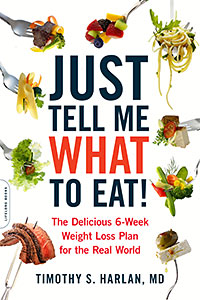
Timothy S. Harlan, MD, FACP has counseled thousands of his patients on healthy, sustainable weight loss. Now he's compiled his best tips and recipes into a six-week plan for you to learn how to eat great food that just happens to be great for you.
Get the prescription for better health as well as healthy weight loss, including:
What to eat
How to cook it
When to eat it
What to eat at a restaurant
What to eat if you're in a hurry
and best of all....
Why eating great food is the best health decision you'll ever make.
The Mediterranean Diet
The Mediterranean Diet is the name that has evolved to symbolize the healthy foods eaten by those people whose countries surround the Mediterranean Sea. Their diets are higher in vegetables, legumes (beans and peas), fruits, nuts and whole grain cereals. The main fat used is olive oil and there is less use of highly saturated fats like butter and lard.
 Instead of beef and poultry as the main animal protein, they eat mostly
fish with some dairy, although much of the dairy is in the form of cultured
products like cheeses and yogurt. The lower intake of poultry and red meats
is coupled with a moderate consumption of wine (mostly with meals).
Instead of beef and poultry as the main animal protein, they eat mostly
fish with some dairy, although much of the dairy is in the form of cultured
products like cheeses and yogurt. The lower intake of poultry and red meats
is coupled with a moderate consumption of wine (mostly with meals).
These ingredients form the basis of Dr. Gourmet recipes. The diet for the most part adds up to fewer calories and better quality foods than the diet that has evolved in America and Western cultures. Interest in this way of eating began because of the longevity of those who have traditionally eaten this way.
The Mediterranean Diet as such was originally recognized by Ancel Keys, a physiologist who believed as early as the 1950s that heart disease was not a necessary part of the ag eing process. Dr. Keys laid the foundations for what we now refer to as the Mediterranean Diet. He lived to be 100 and was active in his field well into his 90s - testimony to the importance of eating well and eating healthy. Next Page »
Research Articles - The Mediterranean Diet
The Mediterranean Diet and Genetics
We know that following the Mediterranean Diet can help reduce
your risk of heart disease, improve your cholesterol scores, and help you
live longer, but what we don't know is WHY that is. Research studies have
suggested that the Mediterranean Diet helps to reduce the systemic inflammation
which has been identified as a major risk of heart disease, but the results
of those studies have been inconsistent at best.
If You Needed Any More Evidence: More
on the Mediterranean Diet
Researchers in Italy recently pooled the results of 12 previously-performed
studies of the effects of the Mediterranean Diet on people's overall health
(BMJ 2008; 337:a1344). These studies included, in total, over 1.5
million people and each study lasted between three and 18 years.
The Mediterranean Diet and Death in
America
I've reported in the past on studies that investigate the Mediterranean
Diet's effects on cholesterol and heart disease. Recently the National Cancer
Institute, in partnership with AARP, published the findings of a long term,
large scale, prospective study (meaning the subjects were followed through
time) on the Mediterranean Diet and its effects on all-cause mortality in
the United States (Arch Intern Med 2007; 167(22) 2461-2468).
Mediterranean Diet, lifestyle factors,
and the elderly
Researchers in the Department of Dietetics at Harokopio University,
in Athens, Greece, evaluated the combined effects of a Mediterranean Diet,
alcohol consumption, physical activity, and other factors on the cholesterol
levels of persons 65 and over.
The Mediterranean Diet and heart attack
survival
We know that the Mediterranean Diet can help prevent cardiovascular
disease, but what if you have an acute coronary event anyway?
Just a little olive oil
Olive oil has a well-deserved reputation for helping to reduce
the risk of heart disease. Most of that reputation is from research into
the Mediterranean Diet, so named because it is a collection of dietary habits
followed by those in the region of the Mediterranean Sea.
More interesting Mediterranean Diet research
Eating a Mediterranean diet has clearly been shown to help reduce
the risk of heart disease. Numerous studies have been completed, but most
have compared the diet to a typical Western diet....
A Mediterranean Diet Won't Make You Fat
You've probably heard that a "Mediterranean Diet" will help you
live longer. . . . Recently, though, there's been some concern that although
a Mediterranean diet might be good for your heart, it appears to lead to
weight gain and obesity.