
Eating Healthy: the Basics
1. What is a healthy breakfast?
2. What is a healthy lunch?
3. What is a healthy dinner?
4. How much should I weigh?
5. How many calories should I be eating?
6. What is the best way to lose
weight?
7. How can I keep my weight loss
goal in mind and stay motivated?
8. What is a healthy weekly weight loss?
9. How to set weight loss goals and make
them happen
10. How to keep a food diary, and
why it is essential to successful weight loss
11. Are all fats bad for you?
12. Are saturated fats bad
for you?
13. Are
unsaturated fats good for you?
14. Are carbohydrates bad for you?
15. Is fiber good for you?
16. How to read nutrition/food labels
17. How to plan your weekly menus
18. Why should I eat less salt?
19. What
do the sodium (salt) numbers mean on food labels?
20. What is The Mediterranean Diet?
21. Why eating vegetables is good for
you
22. Why eating fruit and nuts
is good for you
23. Why are cereals and whole grains good for you?
24. What are legumes, and why are they good for you?
25. Why is eating fish good for you?
26. Which fats and oils are good for
you?
27. Are dairy products good for you?
28. Which meats should I not eat?
29. Is drinking alcohol good for
you?
30. Is it important to measure your
ingredients?
31. Are snacks good for you?
32. How to choose the right portion size
33. Can you lose weight with a smaller
plate?
34. Eat healthier by cleaning out your
pantry
35. Which oils and fats should I keep in my pantry?
35. Which oils and fats are good for you - and when should I use them?
36. Which carbohydrates are good for you?
37. What is the best chicken or turkey for you?
38. Are dairy products good for you?
39. Which nuts and seeds should I eat?
40. Is red meat like beef or pork bad or good for you?
41. Is eating dessert good or bad for
you?
42. Is drinking soda bad for you?
43. Is drinking coffee bad for you?
44. How can healthy food taste good? Part 1
45. How can healthy food taste good? Part
2
46. How to eat healthy while eating
out
47. Are vitamins and supplements necessary
to eat healthy?
48. How to eat healthy while traveling
Eating Healthy: the Basics
Is it important to measure your ingredients?
Real chefs don't measure.
That's a myth. Most chefs do measure, and when they don't, it is because they have been cooking a long time. They understand the amounts of ingredients they are adding because they started out measuring. This is the primary reason you should measure - because you will learn about cooking better.
As you are measuring, it is a great idea to begin learning what is in each measured ingredient. For example, the rule of thumb is that a teaspoon of oil or butter contains about 50 calories and 5 grams of fat. Sometimes the choice of fat might be a little better for you, but whether it is olive oil or butter, the fat you are measure still contains fat and calories.
I have written about how I like to use butter in recipes. It enhances the flavor and texture of recipes in a way that few other ingredients can. Most of the time you don't need much, just a bit works wonders. A chef friend once remarked that it was easy for chefs to hide their sins by simply adding more fat and salt to a recipe. He would say, "You can make bad food taste better with more butter or salt, but it is better to just make great food with the right amount of ingredients." I believe that he's right and that measuring is key to great food.
So when I cook, I measure. This is also one of the simplest tips for reducing calories and eating healthy.
The example of butter is a good one, but again, all fats are calorie dense. Television chefs randomly pour oil into pans without thinking about the added calories. That extra oil doesn't add much to the flavor or texture of their recipes, however.
Salt is the ingredient that I am the most careful with. It's easy to add more sodium to a dish than you need and most recipes are much too salty to begin with. It is easy to cut back on your sodium intake by measuring carefully. A teaspoon of salt has about 2,300 milligrams of sodium. 1/8th teaspoon of salt per portion works to make most dishes just salty enough: this is about 300 mg of added sodium. When I am designing recipes I use this as my starting point, and I reduce or add salt depending on whether there's an ingredient that contains more sodium, such as parmesan cheese or soy sauce.
I like using my salt grinder. I have measured and know that my salt mill dispenses 1/8 teaspoon with ten cranks of the grinder, so that's 1/16th teaspoon with 5 turns. You'll need to experiment a bit with your own grinder to know just how much yours puts out, but it is great for salting fish or meat before cooking, for example. The same applies to my pepper mill.
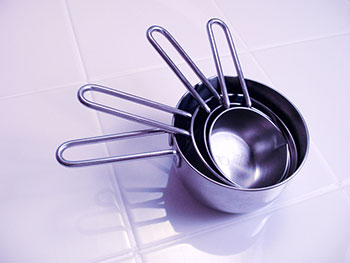
Baking is an exacting science that requires careful measurement to make sure that everything turns out OK. This is the case with cooking as well, and I use measuring cups and spoons for all ingredients, such as milk, chicken stock, flour, rice, oatmeal and the like. There is some research that shows rounding the top of a measuring cup instead of leveling it off can add up to 30% more calories. Measuring keeps excess calories from creeping into your diet.
Professional bakers use scales to measure their ingredients and this is another lesson we can learn from them. If you are going to purchase only one piece of equipment for your kitchen, make it a scale. Weigh your chicken, beef, potatoes, pasta, and the like. Most recipes are written using measuring cups and spoons, but learning to weigh foods helps you to understand what a proper portion size is. You'll quickly get a feel for just how much 4 ounces of chicken or fish is, for instance. This will not only keep you on track with your calories at home, but you will come to realize just how many extra calories there are in restaurant food because you will know what a normal portion size is.
As you are measuring ingredients pay attention to what is in that measure. Over time you will come to find there are similarities in the amount of calories in specific ingredients. For example, 4 ounces of chicken thighs contains 137 calories, 4 ounces of salmon 161 calories and 4 ounces pork tenderloin 124 calories. Not the exact amount of calories across the three but close and by understanding the nutrition information in each ingredient over time you can begin to feel more comfortable reading recipes and knowing whether they are healthy just by looking at the list of ingredients.
Updated October 5, 2015