
Eating Healthy: the Basics
1. What is a healthy breakfast?
2. What is a healthy lunch?
3. What is a healthy dinner?
4. How much should I weigh?
5. How many calories should I be eating?
6. What is the best way to lose
weight?
7. How can I keep my weight loss
goal in mind and stay motivated?
8. What is a healthy weekly weight loss?
9. How to set weight loss goals and make
them happen
10. How to keep a food diary, and
why it is essential to successful weight loss
11. Are all fats bad for you?
12. Are saturated fats bad
for you?
13. Are
unsaturated fats good for you?
14. Are carbohydrates bad for you?
15. Is fiber good for you?
16. How to read nutrition/food labels
17. How to plan your weekly menus
18. Why should I eat less salt?
19. What
do the sodium (salt) numbers mean on food labels?
20. What is The Mediterranean Diet?
21. Why eating vegetables is good for
you
22. Why eating fruit and nuts
is good for you
23. Why are cereals and whole grains good for you?
24. What are legumes, and why are they good for you?
25. Why is eating fish good for you?
26. Which fats and oils are good for
you?
27. Are dairy products good for you?
28. Which meats should I not eat?
29. Is drinking alcohol good for
you?
30. Is it important to measure your
ingredients?
31. Are snacks good for you?
32. How to choose the right portion size
33. Can you lose weight with a smaller
plate?
34. Eat healthier by cleaning out your
pantry
35. Which oils and fats should I keep in my pantry?
35. Which oils and fats are good for you - and when should I use them?
36. Which carbohydrates are good for you?
37. What is the best chicken or turkey for you?
38. Are dairy products good for you?
39. Which nuts and seeds should I eat?
40. Is red meat like beef or pork bad or good for you?
41. Is eating dessert good or bad for
you?
42. Is drinking soda bad for you?
43. Is drinking coffee bad for you?
44. How can healthy food taste good? Part 1
45. How can healthy food taste good? Part
2
46. How to eat healthy while eating
out
47. Are vitamins and supplements necessary
to eat healthy?
48. How to eat healthy while traveling
Eating Healthy: the Basics
How to choose the right portion size
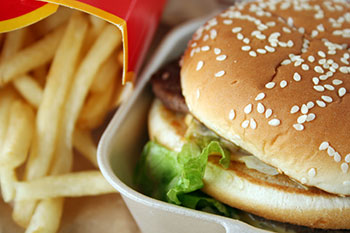
In the last few decades portion size has become a major health issue, with serving size in restaurants increasing dramatically. Forty years ago a 32 ounce milk shake with 1,160 calories would have been unusual. There was no such thing as a Quarter Pounder (let alone a Double Quarter Pounder) and getting a mountain of nachos would be rare. These huge plates have spilled over into how people serve themselves.
For example, the average portion size of salty snacks increased from 132 calories to 225 calories. A portion of french fries increased from 188 to 256 calories. And a portion of Mexican food increased from 408 to 541 calories. It's easy to see why over one-third of the adult U.S. population is obese, since an extra 10 calories a day, every day, adds up to an additional one pound of weight per year. (JAMA 2003 289:450-453)
Even cookbook recipe portion sizes have grown. In a look at the Joy of Cooking over the years, researchers led by Brian Wansink found that between the 1936 edition and the 2006 edition the average number of servings in a recipe decreased by a little over 1 serving per recipe, and the average number of calories in a serving increased by over 60%. What's especially interesting is that Dr. Wansink's team notes that the average serving sizes increased by about 33% (one-THIRD) since 1996. (The Annals of Internal Medicine, 2009;150(4):291)
Another study evaluated the difference in the last two decades in how college students choose meals at a buffet. A study had been done in the late 1980s and was repeated in 2006. 177 students freely served themselves meals which were then weighed. The portions were scored against the recommended portion sizes. The portion sizes chosen for breakfast and lunch in 2006 were found to be more than 125% of the standard portion. Overall, all the portions the students chose were larger than in the 1984 research. (J Am Diet Assoc 2006, 106:1412-1418)
Adding to the difficulty is that people don't really notice that the portions are larger. Brian Wansink, a food researcher, and his colleagues at Cornell University set up a study where they approached people in fast food restaurants and asked them to estimate the number of calories in the meal that they had just eaten. The researchers had been watching and recording what the participants had eaten.
People underestimated the number of calories they'd eaten by an average of 23%. When the researchers looked at the estimates given for supersized meals vs. regular ones, they found that those eating a smaller meal were better able to accurately estimate the amount of calories they had eaten. This wasn't the case with larger meals, where diners underestimated the calories they had just eaten by 38%. Dr. Wansink has been able to recreate these real world findings in his lab in numerous experiments. (Ann Intern Med 2006 145:326-332)
So what works? Portion control.
There are a lot of ways to approach this and a good way to learn portion control is a tool called The Diet Plate. This is a dinner plate with outlines for appropriate servings of a dinner meal printed on the surface. There is a similar cereal bowl with rings painted around the inside to indicate the portion sizes of various types of dry cereal.
In a six month study, those using the calibrated plates and bowls lost significantly more weight. In fact, those who lost weight using the tools lost between 1.8% and 5.7% of their body weight - which is equivalent to a 300-pound man losing between 5.4 and 17.1 pounds. These results are comparable to the results seen in studies of prescription weight loss medications. (Arch Intern Med 2007; 167:1277-1283)
In another study researchers showed that food on plates with wider rims appears about 10% larger than the same amount of food on a plate with a very thin rim. Food on plates with colored rims appears about 3% larger than it does on a plate with a plain rim so even the choice of plate can make a big difference. (JAMA, 2005;293:1727-1728)
In 2004, researchers at the CDC in Atlanta surveyed 2,124 adults who had tried to lose weight in the prior year. 587 had lost weight and kept it off. At the top of the five most common weight-loss strategies was smaller portions (others included reducing the amount of food eaten overall, more fruits and vegetables, fewer fatty foods, and no sweetened beverages). (Int J Beh Nutr Phys Activity 2006, 3:17)
There's good proof that taking the time to learn the right portion size works. Having a scale, measuring cups and spoons on hand is critical to learning what's correct. Here's a guide to the right portion sizes for your recipes:
| Ingredient | Before Cooking | After Cooking | Looks like |
| Grains | |||
| Rice | 1/4 cup | 1/2 cup | 1/2 baseball |
| Pasta | 2 ounces | 1/2 - 2/3 cup | 1/2 baseball |
| Dry cereal | 1 cup | The size of a fist | |
| Potato | 4 ounces | Computer mouse | |
| Potato (mashed) | 4 ounces | 1/2 cup | 1/2 baseball |
| Bread | 1 slice | ||
| Pancake | 1/2 cup batter | Two | Compact disc |
| Bagel | 2 ounces | Hockey puck | |
| Meats | |||
| Beef | 4 ounces | Deck of cards | |
| Pork | 4 ounces | Deck of cards | |
| Veal | 4 ounces | Deck of cards | |
| Fish | 4 ounces | Checkbook | |
| Poultry | 4 ounces | Deck of cards | |
| Peanut butter | 2 Tbsp. | Ping pong ball | |
| Fruits and Veggies | |||
| Salad greens | 1 cup | Baseball | |
| Berries | 1/2 cup | ||
| Apple | 1 medium | Baseball | |
| Orange | 1 medium | Baseball | |
| Raisins | 1/2 cup | Large egg | |
| Dairy | |||
| Cheese | 1 1/2 ounces | 4 stacked dice | |
| Milk | 1 cup | (choose low-fat) | |
| Yogurt | 1 cup | (choose low-fat) | |
| Fats | |||
| Oils | 1 tsp. | Thumb tip | |
| Butter | 1 tsp. | Thumb tip | |