
Mediterranean Diet Basics
The basics of the Mediterranean diet can be broken into 9 important areas of change for your health:
1. Vegetables -
This one's pretty easy. It’s hard to eat too
many vegetables...
2. Legumes - Making beans your choice for
a starch...
3. Fruits and nuts - Fruit is the perfect snack...
4. Cereals - Whole grains are really good for you...
5. Fish - More fish,
less meat...
6. Olive oil - This really means eating more
monounsaturated fat...
7. Dairy products - The traditional
Mediterranean diet doesn’t have
dairy products as a major focus...
8. Meats - Less meat and
lean meats...
9. Alcohol - There is good evidence that moderate
use of alcohol is good for you...
Need more information? Read about the research!
Just Tell Me What to Eat!
The Delicious 6-Week Weight Loss Plan for the Real World
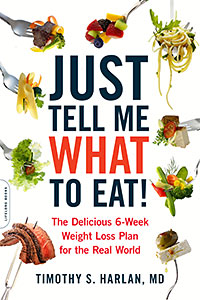
Timothy S. Harlan, MD, FACP has counseled thousands of his patients on healthy, sustainable weight loss. Now he's compiled his best tips and recipes into a six-week plan for you to learn how to eat great food that just happens to be great for you.
Get the prescription for better health as well as healthy weight loss, including:
What to eat
How to cook it
When to eat it
What to eat at a restaurant
What to eat if you're in a hurry
and best of all....
Why eating great food is the best health decision you'll ever make.
The Mediterranean Diet
No. 6 - Oils and Fats
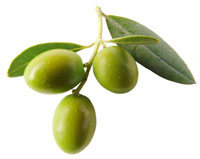 In most studies on the Mediterranean Diet this is generally classified
as olive oil. It really means eating more monounsaturated fat.
In most studies on the Mediterranean Diet this is generally classified
as olive oil. It really means eating more monounsaturated fat.
Olive oil is a good choice and is high in monounsaturated fats but so is canola oil. Grapeseed oil may be an even better oil for you than either olive or canola.
The key is that Dr. Trichopoulou’s research looked at the ratio of monounsaturated fat to saturated fat. The findings are clear that it is very important to decrease the use of highly saturated fats like butter, lard, shortening, palm kernel oil, coconut oil and any oil that has been hydrogenated.
| Good choices | Use carefully | Avoid |
| Olive Oil | Butter | Lard |
| Canola Oil | Coconut milk | Coconut oil |
| Grapeseed oil | Spreads like Smart Balance Light and Promise Light | Stick margarine |
| Safflower oil | Mayonnaise | Vegetable shortening |
| Sesame oil | Avocados | Foods containing hydrogenated oils |
| Tahini (sesame seed butter) | Foods containing palm kernel oil | |
| Peanut butter |
Avocados
Canned
Oil Spray
Canola
Oil
Choosing
Fats
Grapeseed
Oil
Olive
Oil
Olive
Oil, Choosing
Tahini
Research Articles - Monounsaturated Fats (Oils) in The Mediterranean Diet
You can read more about the science of why getting more monounsaturated fats is so good for you in these articles:
10 Things You Need to
Know About Reading Food Labels
There are so many different types of foods out there that make claims about
being healthy. The term "natural" is a good example of packaging
that can be confusing. There is no regulation for the term "natural" and
you could be purchasing a food that is made with 50% lard or is mostly sugar.
10 Things You Need to
Know About Health Claims on Food Labels
The FDA allows health claims to be made on foods, but the assertion does
have to meet certain criteria.
Olive Oil
In my travel this past week I had dinner in a restaurant
that has been acclaimed in a number of food magazines as being one of the
best in America. It certainly did not live up to its reputation, in spite
of the apparent feeling of the staff that we were being treated to something "really
special."
In Your Pantry: Fats
This week I get to talk a little about
fats. I like to keep this simple. There's a lot of choices, and you could
fill your house with bottles of different oils, but the following are the
basic items that you should always have on hand and ones that you will use
regularly for healthy cooking.
In Your Pantry: Refrigerator
Items
This week is a very simple
list of the items that you should begin stocking in your refrigerator. This
is far from what might be a complete list but a starting place for those foods
that will let you always have something healthy in the house to start (or
complete) a meal or have a healthy snack.
Just a little olive oil
Olive oil has a well-deserved reputation
for helping to reduce the risk of heart disease. Most of that reputation
is from research into the Mediterranean Diet, so named because it is a collection
of dietary habits followed by those in the region of the Mediterranean Sea.
Yet another reason to avoid
trans-fats
You've seen it in the
news: Trans-fatty acids have been linked to an increased risk of inflammation
(leading to heart disease and cancers), insulin resistance and type 2 diabetes.
Researchers at Harvard and the Brigham and Women's Hospital in Boston, Massachusetts
noted recently that factors relating to insulin
sensitivity may have an effect on female infertility, which affects about
7 million women who are trying to conceive. Could eating foods containing trans-fatty
acids be linked to infertility?
Tomatoes, Olive Oil, and Heart
Disease
The Mediterranean Diet
has been shown to protect against heart disease, but just why it does so isn't
quite clear. Its effects have been credited to a variety of foods in the typical
Mediterranean Diet, including components of the fruits and vegetables and the
red wine.
Clinically proven!
More and more such claims as "clinically
proven" are being found on food products. This is due to a wave of "functional
foods" that are hitting the market. In some cases these can be great products
with cholesterol lowering properties. In other cases the claims made are dubious.
Not just a monounsaturated fat
anymore
I wrote yesterday about the effect
of polyphenols in fruit juices on the risk of Alzheimer's disease. Polyphenols
aren't just in fruit juices, however. Another excellent source of polyphenols
is virgin olive oils, the oils from the first pressing of olives. The heart-healthy
effects of the olive oil in the Mediterranean Diet has often been attributed
to its being a monounsaturated fat, but researchers in Europe theorized that
they might be the polyphenols in the olive oil
Small Changes Can Have
a Big Impact
You probably are aware that
being overweight has a negative impact on your blood pressure, and that high
blood pressure can lead to stroke and heart attack and even death. Losing weight
is the obvious answer, but how much weight do you have to lose to make a difference
in your heart health?
Dietary Fat and the Risk of
Alzheimer's Disease
It has become
clearer and clearer that diets high in saturated fat and trans fats are associated
with health problems. I have written about many different research studies that
link diets high in these types of fats with heart disease and stroke. Recently,
however, a very well designed study shows a clear connection between Alzheimer's
Disease and an increased intake of saturated and trans fat.
Good Fats Appear to Protect
You From Pneumonia
Much has been
written in my columns and in the press about good fats. A great deal of research
has gone into this in the last few years, and while our knowledge is still evolving,
it appears that eating foods rich in Omega 3 fats and Omega 6 fats is beneficial
to your health.