
Special Diet Information
Coumadin® (Warfarin)
This recipe is safe for Coumadin (warfarin) users.
Lactose
This recipe is safe for those who are lactose intolerant.
Sodium
This is a low sodium recipe.
GERD / Acid Reflux
This recipe contains GERD triggers and those with GERD may wish to avoid it.
Gluten Sensitivity
This recipe is safe for those who are sensitive to gluten. Serve with gluten-free roll.
"Memories are like mulligatawny soup in a cheap restaurant. It is best not to stir them." -P. G. Wodehouse, British Author
The refrigerator light goes on...
This is another good example of not judging a dish by its recipe. When I first read a mulligatawny recipe I couldn't see that it would taste good. Man, was I wrong.
There is a perfect blend of ingredients here: great veggies, turkey, apples, and tomatoes all together in a curried chicken broth. The key to this soup is to not overheat it or it will become cloudy and the apples will lose too much of their crispness. You want to just heat the apples through until they are hot but still with a bit of crunch.
This is a perfect recipe for using your leftover turkey from a holiday meal. Personally, I would not make this with a deli style turkey – use the real thing. It is worth the effort to cook a turkey breast and plan for this soup as one of the leftover recipes.
Mulligatawny
Servings: 4 | Serving size: 2 cups
Cooking Time: 60 Minutes
This recipe can easily be multiplied, keeps well for 4 - 5 days (refrigerated), and is better the second day. Serve with a 1 ounce whole wheat or gluten-free roll.
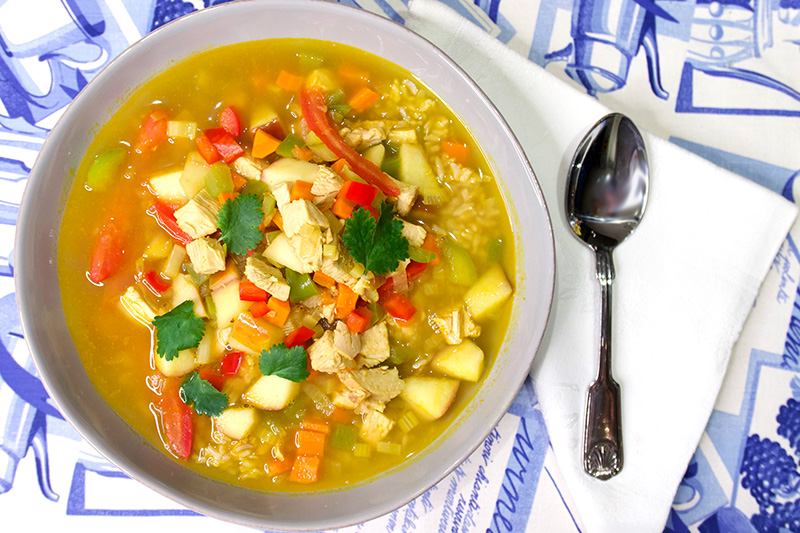
Ingredients
- 2 1/2 cups water
- 1/2 cup brown rice
- 1/2 medium onion (diced)
- 1 medium celery (diced)
- 1 large carrots (diced)
- 1/2 medium green bell pepper (diced)
- 3 cups reduced-sodium, non-fat chicken stock
- 2 tsp. curry powder
- 1/4 tsp. salt
- 8 ounces fresh tomatoes (seeded and cut into julienne strips)
- 1/2 lb. cooked turkey breast (1/2 inch cube)
- 1 large apple (1/2 inch cube)
Place the water in a medium sauce pan over high heat.
When the water boils, add the brown rice and stir once.
Reduce the heat to a simmer and cook until all of the water is gone (do not stir the rice while it is cooking).
Set aside.
Place the olive oil in a large skillet over medium high heat.
Add the onions and celery.
Cook for about 3 minutes. Stir frequently.
Add the carrots and bell pepper. Cook for about 3 minutes and stir frequently.
Add the chicken stock and heat over low heat.
Add the curry powder and salt.
Simmer for about 5 minutes.
Add the tomatoes, turkey, and apples to the soup.
Cook over low heat for about 5 minutes and serve over the brown rice.
Nutrition Facts
Serving size: about 2 cups
Servings: 4
Amount Per Serving
| Calories 500 | Calories from Fat 63 |
| % Daily Value |
| Total Fat 7g | 9% |
| Saturated Fat 1.5g | 7% |
| Monounsaturated Fat 3g | |
| Trans Fat 0g | |
| Cholesterol 90mg | 30% |
| Sodium 500mg | 22% |
| Total Carbohydrates 63g | 23% |
| Dietary Fiber 8g | 27% |
| Sugars 20g | |
| Protein 46g |
| Vitamin A 40% | Vitamin C 54% |
| Calcium 5% | Iron 12% |
| Vitamin K 30mcg | Potassium 1400mg |