
Special Diet Information
Coumadin® (Warfarin)
This recipe is safe for Coumadin (warfarin) users.
Lactose
Avoid this recipe if you are lactose intolerant.
Sodium
This is a low sodium recipe.
GERD / Acid Reflux
This recipe contains GERD triggers and those with GERD may wish to avoid it.
Gluten Sensitivity
This recipe is safe for those who are sensitive to gluten.
"Some writers say the leaves [cilantro] are used for seasoning, but this statement seems odd, as all the green parts of the plant exhale a very strong odor of the wood-bug, whence the Greek name of the plant." -Vilmorin-Andrieux, Author, "The Vegetable Garden" (1885)
The refrigerator light goes on...
When I talk about Mediterranean diet I think about specific ingredients that go into a recipe – quality oils and fats, vegetables and seafood, for example. As such, those principles easily translate to so many different types of cuisine and this Indian Shrimp Curry is a great example of how well Mediterranean diet principles translate to other cuisines.
Take some time to select your curry powder and try a few different versions. Some can be quite spicy and it is a good idea to add your curry powder a teaspoon at a time so that your recipe is not overwhelmed by too much curry powder.
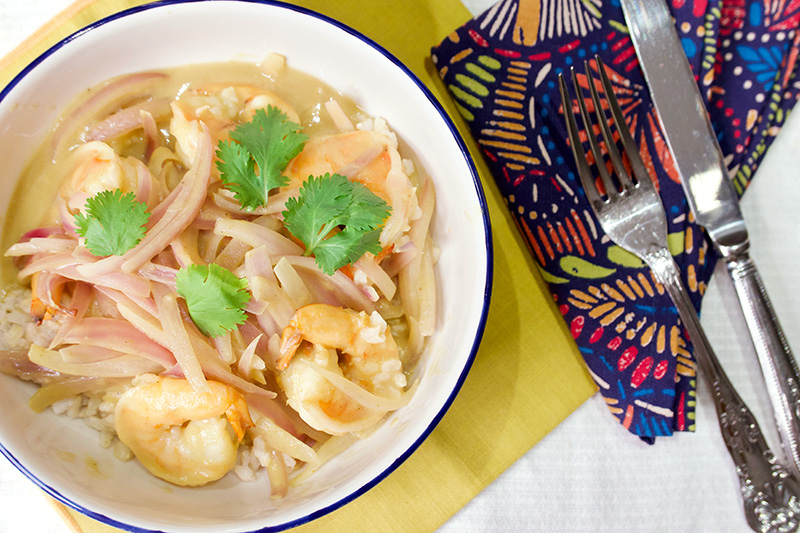
Indian Shrimp Curry
Servings: 4 | Serving size: about 2 cups (4 ounces shrimp)
Cooking Time: 30 Minutes
This recipe can easily be multiplied and leftovers are great. Serve with Brown Rice or Coconut Brown Rice.
Ingredients
- 2 tsp. extra virgin olive oil
- 2 cloves garlic (minced)
- 1 medium white onion (sliced)
- 1 medium red onion (sliced)
- 1 cup 2% milk (divided)
- 1 Tbsp. corn starch
- 1 Tbsp. curry powder
- 2 tsp. garam masala
- 2 tsp. honey
- 1/2 tsp. salt
- 1 cup low-fat (lite) unsweetened coconut milk
- 1 lb. large shrimp (peeled and deveined)
- 4 Tbsp. fresh cilantro leaves
Heat the olive oil in large non-stick skillet over medium-high heat.
Add the garlic and onion and reduce the heat to medium.
Cook gently, stirring frequently, until the onions begin to soften.
While the onions are cooking, place the cornstarch in a cup and add 1/4 cup of the 2% milk, stirring until the cornstarch is dissolved.
After the onions are soft, add the curry powder, honey, salt, lite coconut milk, and remaining 2% milk to the skillet.
Stir well until the ingredients are well blended and then add the milk/cornstarch mixture.
Reduce the heat to medium-low and cook for about three minutes.
Add shrimp and simmer until they are opaque in center (about 5 minutes).
Serve the curry over Brown Rice and top with 1 tablespoon cilantro leaves per serving.
Nutrition Facts
Serving size: about 2 cups (4oz shrimp)
Servings: 4
Amount Per Serving
| Calories 220 | Calories from Fat 72 |
| % Daily Value |
| Total Fat 8g | 10% |
| Saturated Fat 5g | 19% |
| Monounsaturated Fat 2g | |
| Trans Fat 0g | |
| Cholesterol 185mg | 61% |
| Sodium 460mg | 20% |
| Total Carbohydrates 16g | 6% |
| Dietary Fiber 2g | 9% |
| Sugars 8g | |
| Protein 26g |
| Vitamin A 0% | Vitamin C 6% |
| Calcium 8% | Iron 9% |
| Vitamin K 6mcg | Potassium 500mg |