
Just Tell Me What to Eat!
The Delicious 6-Week Weight Loss Plan for the Real World
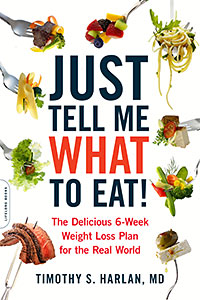
Timothy S. Harlan, MD, FACP has counseled thousands of his patients on healthy, sustainable weight loss. Now he's compiled his best tips and recipes into a six-week plan for you to learn how to eat great food that just happens to be great for you.
Get the prescription for better health as well as healthy weight loss, including:
What to eat
How to cook it
When to eat it
What to eat at a restaurant
What to eat if you're in a hurry
and best of all....
Why eating great food is the best health decision you'll ever make.
Physician Resources
What is the Arthritis Known as Gout?
Many foods contain purine molecules. Along with amino acids (which make up proteins) and other molecules purines are a source of nitrogen for your body. When purines are processed they are broken down into uric acid so that the body can get rid of some of the nitrogen. In some people uric acid is not processed properly and the levels in the bloodstream can get too high. When this happens the molecule can form small crystals that deposit in joints causing a painful arthritis known as gout.
There are ingredients that are higher in purines that can cause a problem for people with gout. Limiting these ingredients is one key to helping prevent a flare of the arthritis.
How to Help Prevent Gout Symptoms
There are other measures that can help prevent gout including limiting the intake of alcohol. People who are overweight are at higher risk and weight loss is important in preventing gout flares. A heart healthy diet is valuable because higher fat diets can increase the retention of uric acid.
Legumes such as peas, peanuts, beans and soy products contain moderate levels of purines. These ingredients can be included in the diet carefully. The foods to completely remove from your diet are most organ meats (kidneys, liver, sweetbreads), game meats, anchovies, sardines, herring, mackerel and scallops.
Purine content of foods
| Food Group | Low Purine
(0-50 mg purines per 100 grams) |
Moderate Purine (50-150 mg purines per 100 grams) |
High Purine (150 - 825 mg purines per 100 grams) |
| Use freely | Use in moderation | Avoid if possible | |
| Breads and Cereals | Breads, noodles, cereals, rice, cornbread, polenta, grits | Limit to 2/3 cup uncooked per day: oatmeal Limit to 1/4 cup uncooked per day: wheat bran, wheat germ |
|
| Fruit | All fruits are OK including fruit juices.
Fresh cherries, strawberries, blueberries, and other red-blue berries may be especially good for gout. Pineapple is high in bromelain and may be good for those with gout. |
||
| Vegetables | Most vegetables | Limit to 1/2 cup serving of cooked per day: asparagus, cauliflower, spinach, mushrooms, green peas | |
| Protein Foods* | Eggs, nuts, peanut butter | Limit to 1 or 2 servings per day:
Red meat (beef, pork, venison), poultry (3 ounces per serving) Fish, shellfish (3 ounces per serving) Dried peas, dried beans, dried lentils (1 cup cooked) |
Organ meats like liver, kidney, heart, brains,
sweetbreads
Game meats like goose, duck and partridge Some fish are high in purines including anchovies, sardines, mackerel, herring, scallops, mussels |
| Milk & dairy products | All (Choose low fat products) | ||
| Fats & Oils: Limit use of fats & oils |
All (in moderation) | Gravies may have concentrations of meat essence and higher purine content. | |
| Soups | Vegetable soups made with vegetable stocks | Meat soups and broths | Meat extracts Yeast (as a supplement) |
| Beverages | Coffee, cereal beverages
decaffeinated coffee Drink water as your beverage of choice. Fruit juices are safe for those with gout. |
Beer and other alcoholic beverages (limit to occasional intake of 1 drink) | Beer and other alcoholic beverages (some may have to eliminate from the diet completely) |
| Misc. | Sugar syrup, sweets, gelatin, soft drinks, tea
Chocolate, custard, pudding White sauce, salt, fresh and dried herbs, olives, pickles, relishes, vinegar, popcorn |
Mincemeat |
* As with any healthy diet, choose lean meats and poultry without the skin. As with any healthy diet, fish is a good choice. Cook proteins with little added fat.
Download
this document as a printer-friendly pdf:
Gout
Basics
Don't have Adobe® Acrobat® Reader®? Download it now.