
Just Tell Me What to Eat!
The Delicious 6-Week Weight Loss Plan for the Real World
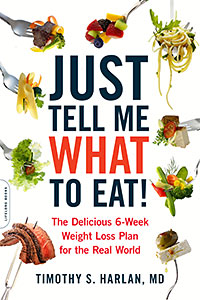
Timothy S. Harlan, MD, FACP has counseled thousands of his patients on healthy, sustainable weight loss. Now he's compiled his best tips and recipes into a six-week plan for you to learn how to eat great food that just happens to be great for you.
Get the prescription for better health as well as healthy weight loss, including:
- What to eat
- How to cook it
- When to eat it
- What to eat at a restaurant
- What to eat if you're in a hurry
- and best of all....
- Why eating great food is the best health decision you'll ever make.
Just Tell Me What to Eat!
The Delicious 6-Week Weight Loss Plan for the Real World
Timothy S. Harlan, MD, FACP has counseled thousands of his patients on healthy, sustainable weight loss. Now he's compiled his best tips and recipes into a six-week plan for you to learn how to eat great food that just happens to be great for you.
Get the prescription for better health as well as healthy weight loss, including:
What to eat
How to cook it
When to eat it
What to eat at a restaurant
What to eat if you're in a hurry
and best of all....
Why eating great food is the best health decision you'll ever make.
Guest Columnists
Elaine Hicks
Following the Just Tell Me What to Eat! diet
plan
 Dr. Tim Says: Elaine is a colleague of mine at Tulane and she has
been using the new book to lose weight and help with her hypertension
and high cholesterol. Her story is really interesting and we'll have
a new post every Monday. Follow Elaine as she uses the new book!
Dr. Tim Says: Elaine is a colleague of mine at Tulane and she has
been using the new book to lose weight and help with her hypertension
and high cholesterol. Her story is really interesting and we'll have
a new post every Monday. Follow Elaine as she uses the new book!
Before Day One
This is not a diet!
Be Prepared
Staying on Track
Managing: Bring the Wine AND Dessert
Dr. Gourmet and Road Food
Simple changes: food and activity FEEL good
Slowing down
 Jacques
Courseault, M.D.
Jacques
Courseault, M.D.
Exercise Right!
Dr. Jacques graduated from Tulane University School of Medicine and is a resident in Physical Medicine and Rehabilitation at Louisiana State University.
He has seven years experience as a personal trainer and is the Co-Founder of Don't Weight to Lose (a non-profit New Orleans based weight loss program). Learn how to exercise right with Dr. Jacques' articles at DrGourmet.com.
How to Begin an Exercise Regimen
Walk Your Way to Better Health
How to Begin a Walking Program
Eating and Exercise: What to eat and when to eat it
Weight, Lean Body Mass and Exercise
Strong Muscles Fight Disease
How to Exercise with Disabled or Weak Legs
How to Conserve Muscle Mass During Weight Loss
How to Build Muscle Mass
How to Build Muscular Endurance
Exercise Ideas: Play Video Games!
Exercise Improves Eating Habits
Faith Bontrager, RN, BSN
Eating Healthy During Pregnancy
 Faith
is a nurse who has supported birthing families for years. She has
an Associate degree in Nursing from the University of Nebraska Medical
Center and a Bachelors degree in Nursing from Purdue.
Faith
is a nurse who has supported birthing families for years. She has
an Associate degree in Nursing from the University of Nebraska Medical
Center and a Bachelors degree in Nursing from Purdue.
Faith started life with an early appreciation for good food (Thanks for the breast milk, Mom!). Whether learning to make compost for the vegetable garden from her father, Pennsylvania Dutch pies from her mother, or being given the freedom to experiment in the family kitchen, healthy food was an important part of growing up.
Using medical knowledge to care for others was also important. Whether applying band aids and salve to scrapes or bringing tea and toast to those “under the weather,” Faith felt a calling early in life to help those in need of healthcare.
Faith's passion in nursing is to help people find the options they need to discover their personal path to optimum health. Ask her friends and they will tell you that their appreciation of nutritious food has grown through Faith. Nutrition is an important part of health. The body can only build with the tools that nutrition provides. Quality food meets the nutrient needs of the body. Preparing and enjoying satisfying foods feeds the whole person.
Faith has taught various health topics including childbirth classes and first aid and is active in natural farming circles. She is currently part of an interdisciplinary research team exploring the role of social support for women who have miscarried.
Faith has spent much of her life in the Midwest but recently re-located to the Mississippi gulf coast. She enjoys cooking for family and friends, teaching on nutrition and health, and volunteering at a free health clinic. She is using her free time to expand her repertoire of fresh seafood dishes!
Thinking About Getting Pregnant?
Congratulations on Your Pregnancy! (for those who are newly pregnant)
What is a healthy pregnancy weight gain?
Can I continue to eat a vegetarian diet during pregnancy?
A Pregnancy Menu For You and Your Baby
Treating Nausea and Vomiting
What About Seafood?
Don't Eat That!
Pregnancy and Cholesterol
Wash Those Veggies!
Breastmilk, the Healthiest Diet for Babies
What DOES that Broccoli Do for My Baby?
Vitamin D Supplements in Pregnancy and Breastfeeding
New Research Affirms Individualized Vitamin D Supplementation for Pregnant Women
Breastfeeding: Developing a Future Gourmet
What to Do About The Flu
Gestational Diabetes
Decreasing the Risk of Gestation Diabetes
Keeping and Storing Breastmilk
Pregnancy Weight Gain Guidelines – Do We Need New Ones?
Breastfeeding: A Woman's Health Issue
Eating During Labor
Probiotics and a Decreased Risk of Gestational Diabetes
Pregnancy - a Time to be Active!
Clearing the Air : Quit Smoking for You and Your Child
What is a Healthy Pregnancy Diet for Obese Women?
Does Iron Intake Matter?