
It's easy to get answers about health and nutrition! Just send your question by email to [email protected] and Dr. Harlan will respond to selected questions of general interest. Answers will be posted in the Ask Dr. Gourmet newsletter (sign up now!) and archived in the Ask Dr. Gourmet section of the website.
Please note that the Ask Dr. Gourmet feature is restricted to questions regarding food and nutrition. Due to the many questions we receive, not all questions may be answered. For more specific questions about your individual health, please contact your doctor. About Timothy S. Harlan, MD, FACP, CCMS | Terms of Use | Privacy Policy
Ask Dr. Gourmet
Why does Swiss cheese have holes in it?
Why does Swiss cheese have holes in it and other cheeses do not?
Dr. Gourmet Says...
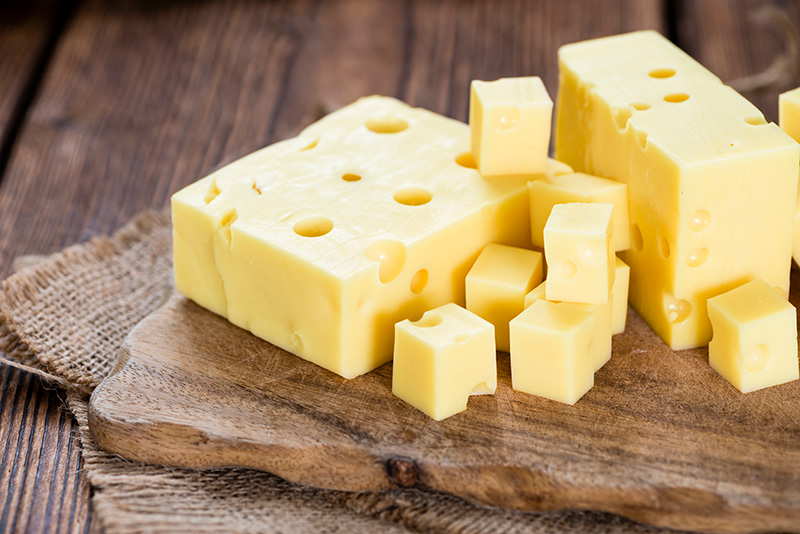
Like yogurt, cheese is made by adding live bacteria to milk. The resulting fermentation gives off gasses and it is the bacteria that is used in making Swiss cheese that is responsible for the large holes. One of the three bacteria used in Swiss cheese is Propionibacter shermani. For some reason this bacteria makes the the cheese's distinctive larger holes.
Once P. shermani and other bacteria are added to the milk mixture it is warmed and bubbles of carbon dioxide form. The bubbles come together to create the large holes. In the cheese industry the holes are called "eyes."
Interestingly, USDA regulations state that the holes in Swiss cheese must be between 11/16 and 13/16 inches in diameter.
Thanks for writing,
Timothy S. Harlan, MD, FACP, CCMS
Dr. Gourmet